When Davis first encountered an overdose, he wasn’t a nurse yet. He was working at a bank when he came across a person who had stopped breathing. He used his First Aid training to keep them in the recovery position while monitoring their vitals until an ambulance arrived. That moment planted a seed that would eventually lead him out of banking and into nursing school at Conestoga College in his hometown of Kitchener.
Nursing wasn’t a completely foreign idea for Davis as his grandmother was a nurse and his mom was a nurse, and he’d always had something of a caretaker mentality. “I do tend to run towards the emergency and not away from it,” he says with a laugh. “Which is good and bad.”
After graduating in 2017, Davis worked in community nursing, then medicine, then the emergency department. In the ED, he saw something that troubled him. “The treatment for people that are overdosing is to Narcan them, treat the substance more than the individual,” he says. “There’s almost an unspoken bit of judgment. We’re preventing the overdose, which is good, but then there’s really no support.”
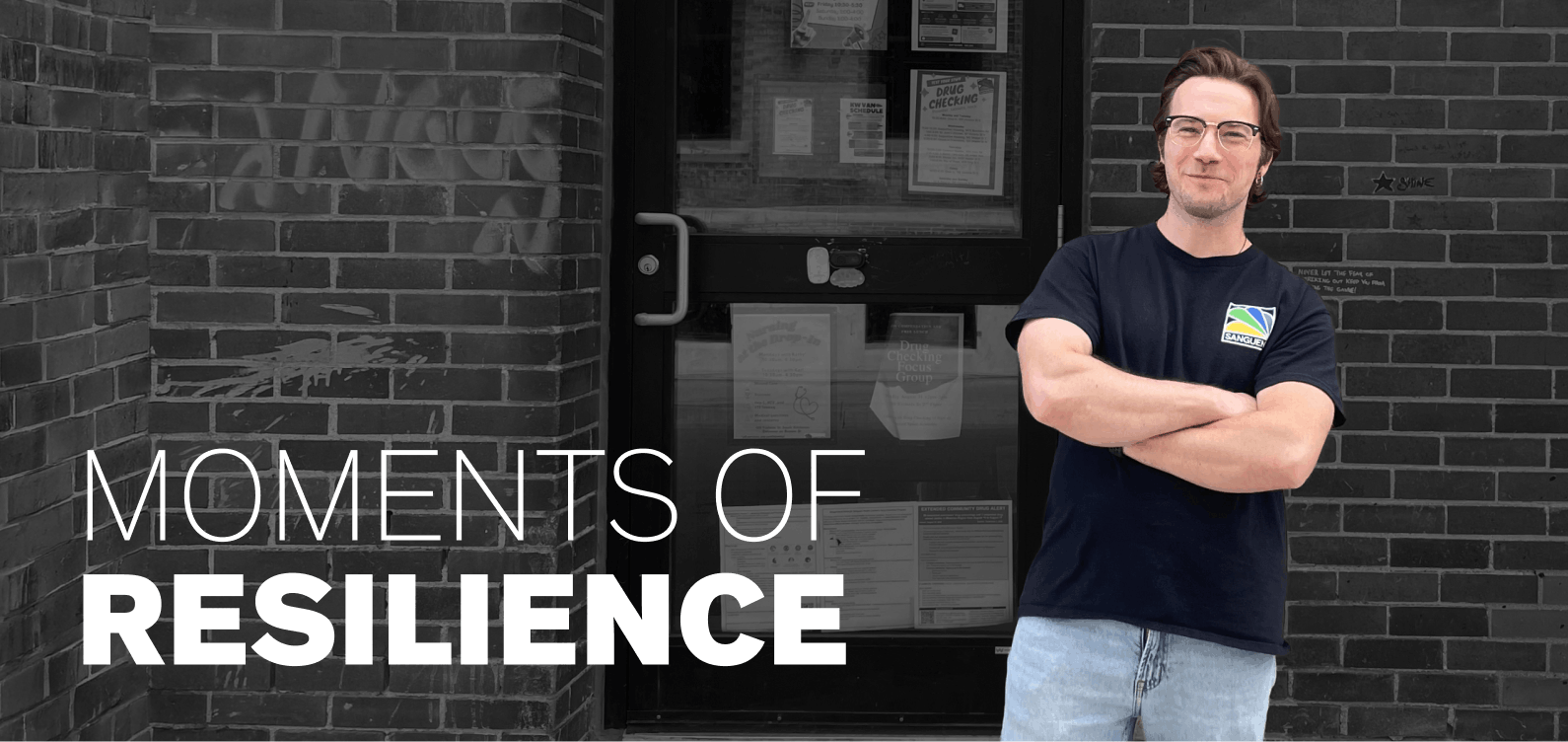
That disconnect led him to Sanguen Health Centre, where he now works in harm reduction on a team that supports people who are transitioning into supportive housing, often after spending years in homelessness. It’s a role he almost didn’t take. “I had to be coerced into applying,” he admits. “I just never looked at it in the right way.”
For Davis, harm reduction is about accepting people as they are. “We’re not trying to remove the harm or judge the individual,” he explains. “We accept that they’re free to make these choices, but we can still treat them with dignity and give them the safest option possible.” He’s seen how building trust with patients can eventually lead to conversations about replacement therapy, to health information and best practices that land, and to better outcomes that aren’t necessarily defined by abstinence.
The work takes a toll. In the four days before our interview, Davis and the team had received a drug alert for Waterloo Region that was reporting 37 suspected overdoses and one death. “It’s overwhelming,” he says quietly.
So how does he stay resilient? For Davis, resilience is rooted in advocacy and perspective. He talks about the “scarcity mindset” which he sees everywhere.
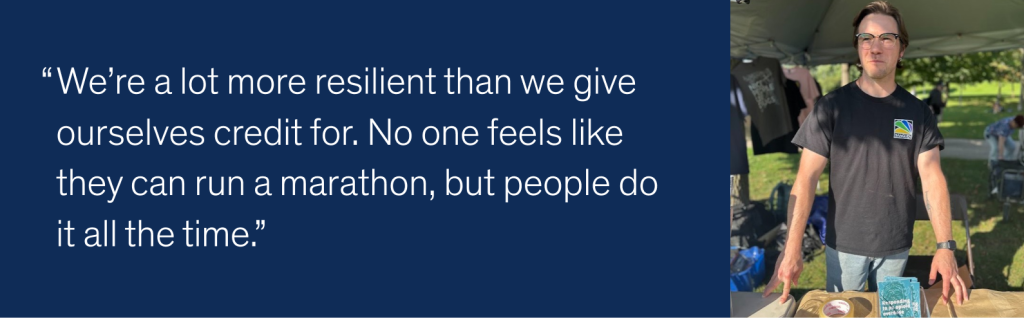
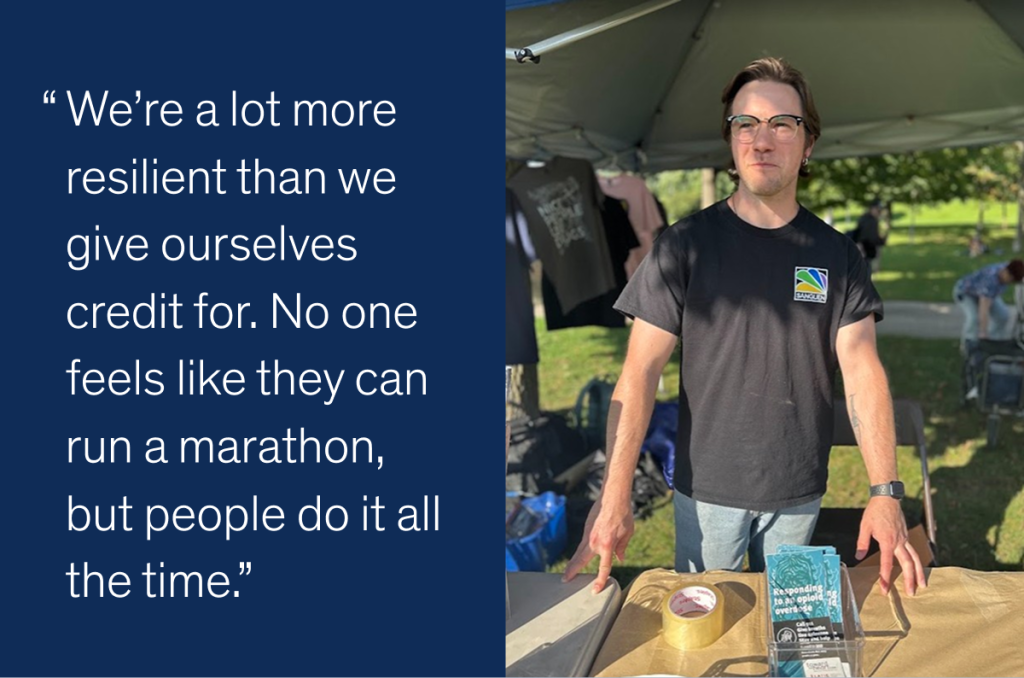
People telling themselves they don’t have enough time, they can’t take on one more thing, they’d love to help but it’s just not possible. He likes to challenge that thinking in himself whenever possible. “I feel like people have been kind of shrunk recently,” he says. “We’re a lot more resilient than we give ourselves credit for. No one feels like they can run a marathon, but people do it all the time.” For him, resilience is about refusing to let that shrinking happen and reminding himself and others that we’re more capable than we think.
He also finds hope in witnessing small transformations. “Some of the individuals I see don’t think they’re capable of putting shoes on in the morning, and you see the change, and the ripple effect from one small change.” If harm reduction can work for people who have very little, he reasons, imagine what collective advocacy could do with more resources and more voices.
Davis has a simple message for other RPNs considering harm reduction: explore it. He admits that early in his career, he bought into the idea that community nursing meant losing your skills and that the hospital was where you went to build real competence. But his experience at Sanguen changed his mind. “I think it’s more about encouraging every nurse to really explore the different facets,” he says. “The hospital is great for some individuals. But we’re all different and we prioritize different things.”
He thinks community nursing is a great environment to build new skills and expertise. “I’ve been an RPN long enough that certain skills weren’t performable by RPNs when I started, and now they are,” he says. “Advocating for yourself and gaining knowledge in any capacity will always serve you well, and it will be reflected in your practice.”
He also speaks openly about his own path – including a decision not to bridge to RN, after he began the process, something he once carried guilt about. “I’ve realized working in so many different roles as an RPN is that there’s a lot that we’re capable of doing. “
His advice for staying resilient? Keep talking. Keep advocating. “If the person suffering from it is not able to bring attention to it, then I can do it, or two of us can, or eventually the whole community can.”
For Davis, resilience isn’t about toughing it out alone. It’s about showing up, speaking up, and trusting that small acts of care and advocacy add up to something bigger, one conversation, one pair of shoes, one person at a time.