
After more than 25 years in nursing, Babita has seen the healthcare system from nearly every angle—long-term care, urgent care, family practice, and over a decade in one of Ontario’s busiest emergency departments.
Today, her work spans both system-level support through WeRPN and direct patient care in a high-risk HIV/STI clinic. Together, these roles reflect what equity in action truly looks like: meeting people where they are, without judgment, and with compassion.
Babita’s path into nursing wasn’t driven by a single moment, but by a steady commitment to growth. “You move through different roles, you learn, you adapt,” she says. Over time, she built a wide-ranging skill set, eventually spending more than a decade in emergency care in Brampton—one of the most culturally diverse regions in the province. There, she regularly cared for hundreds of patients a day from all walks of life.
What stayed with her most from those years wasn’t just the pace—it was the gaps.
“There just weren’t enough supports,” she reflects. “You might have one social worker for the whole hospital. Meanwhile, you’re trying to help people through situations you may not have the full training or resources for.” That experience continues to shape how she approaches care today.
In her role with WeRPN, Babita now supports nurses entering or re-entering the workforce, many of whom are internationally educated or navigating new systems. Equity shows up here in mentorship—helping individuals understand expectations, build confidence, and navigate barriers that may not be obvious to others.
She recalls advocating for the addition of a “preferred name” field on application forms—something small, but meaningful. “We make assumptions based on names,” she says. “Why not just ask people how they want to be identified?” It’s a practical example of how inclusive thinking can reshape systems in simple but impactful ways.
But it is in her clinical work where Babita’s approach to equity is most visible.
At the high-risk HIV/STI clinic, she works with patients who often face overlapping challenges: lack of insurance, unstable housing, stigma, and barriers tied to identity or immigration status. The clinic is intentionally designed to reduce those barriers, operating within a shared community space that offers immediate access to food, social supports, and other essential services.
“People come in for bloodwork, and then they start telling you their whole story,” Babita says. “They’ll tell you they haven’t eaten, or they’re homeless, or their partner is abusive.”
Her role in those moments isn’t to judge or direct—it’s to listen, connect, and respond. She creates space through small, intentional interactions: a familiar greeting, a bit of humour, a question that invites conversation. From there, trust builds.
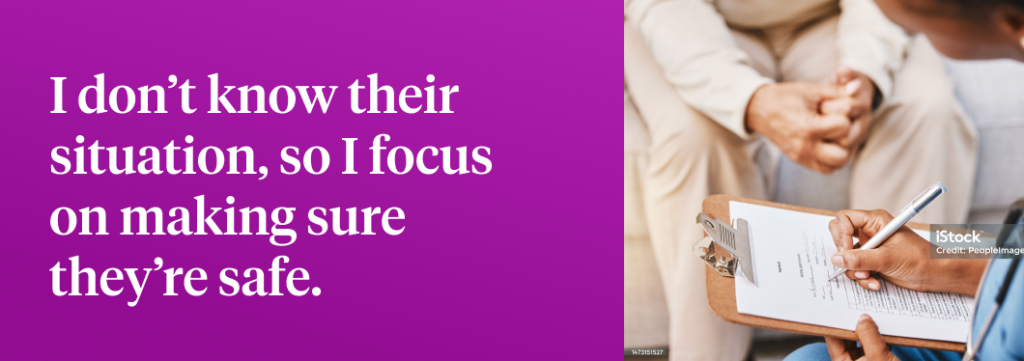
That trust is critical when working with populations who have often experienced harm or discrimination in healthcare settings. Babita approaches each interaction through a trauma-informed lens, recognizing that every patient brings a unique history. “I don’t know their situation,” she says. “So, I focus on making sure they’re safe.”
That philosophy extends to her understanding of harm reduction. Rather than focusing on behaviour as “good” or “bad,” Babita, or “Nurse Babs” as her patients call her, centres care on safety, dignity, and health outcomes. Nowhere is this more evident than in her work with HIV patients.
“We’ve seen people come in at their worst,” she says. “And now they’re illness is undetectable, they’re healthy, they have partners, families.”
For Babita, these outcomes are proof that equitable, non-judgmental care works—not just for individuals, but for the system. Supporting patients early and consistently prevents more serious health crises later.
Her work also highlights the importance of wraparound care. While starting patients on necessary medications and treatments are important, having access to on-site supports, whether it’s food, hygiene products, or a social worker, means patients can get what they need in real time. In addressing their immediate needs, space is made for the individual to focus on their healthcare.
Across both of her roles, Babita returns to one core idea: compassion.
She worries that in a fast-paced, evolving healthcare system, that value can sometimes be lost. “If you don’t have empathy and compassion, it’s going to be hard to stay in this work,” she says.
At the same time, she emphasizes that equity is not something providers can ever fully “master.” It requires continuous learning, humility, and openness. “Things change all the time,” she says. “You have to ask questions. You have to be okay saying you don’t know.”
In a system facing growing complexity and demand, Babita’s approach offers a grounded reminder: equity in action isn’t about having all the answers—it’s about showing up, staying curious, and caring for people as they are.