When Marissa Bradley’s mother first encouraged her to pursue nursing, she steadfastly refused. Years later, after working as a PSW in long-term care and completing her practical nursing program, she found her way to the profession anyway—drawn not by family tradition, but by a passion for mental health. Today, Marissa is a bedside RPN in a mental health unit at a multi-site hospital in London, Ontario. She is also the 2025 recipient of the WeRPN Research Fellowship.
Her path to research began, unexpectedly, through her participation on the hospital’s nursing council. As co-chair representing inpatient nursing, Marissa noticed a striking imbalance: among roughly 36 nurses on council, there were only five RPNs. When the group did the math, the disparity was stark and Marissa wanted to know why.
Around the same time, Marissa and two colleagues learned about WeRPN’s research funding at a conference. “We all kind of looked around the table at each other and gave each other a nudge,” she recalls. “We could do something with this.” They applied for the RPN Research Fellowship and were awarded it in July of last year.
The WeRPN Research Fellowship is a one-year program offering up to $12,500 in funding to help RPNs build applied research knowledge and capacity in real-world clinical contexts, facilitate a culture of curiosity and nursing practice improvement, and nurture confidence and competence in RPN-driven research. For Marissa, that support proved transformative. The fellowship funding created protected time for her to step off the floor and focus on the project—something she believes made it possible. “Had we not been approved, I could only imagine how much longer it would have taken,” she says. “Being on a unit is busy. I work 12-hour shifts. I wouldn’t have had the time.”
What followed was still a steep learning curve. Marissa and her supervisor navigated ethics approval, switched their survey platform, and learned to use a software program called SPSS for data analysis. This was all accomplished while still working full-time at the bedside. “There were times I thought, what have I got myself into?” Marissa admits. But the fellowship’s protected time, paired with WeRPN’s encouragement, carried the project through. Their study, which used a motivation scale to explore why RPNs were underrepresented on the nursing council, surfaced three key barriers:
- nurses not understanding what the council does,
- lacking protected time to participate,
- and nurses feeling unsupported, whether by colleagues or leaders.
The outcomes extend well beyond the research itself. The project has sparked conversations about creating a dedicated research-based council within the hospital, in collaboration with the Lawson Health Research Institute, which has also begun restructuring to better support frontline nurses who want to pursue research. And when Marissa presented the work at a nursing summit during Nurses Week, the response was immediate. “We had nurses come up to us saying, I didn’t realize how much nursing council does,” she says. “I didn’t know these opportunities existed.”
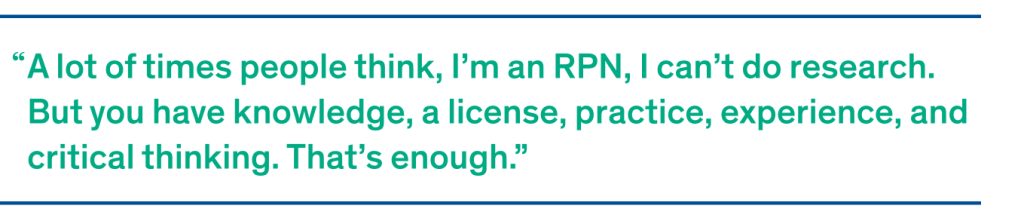
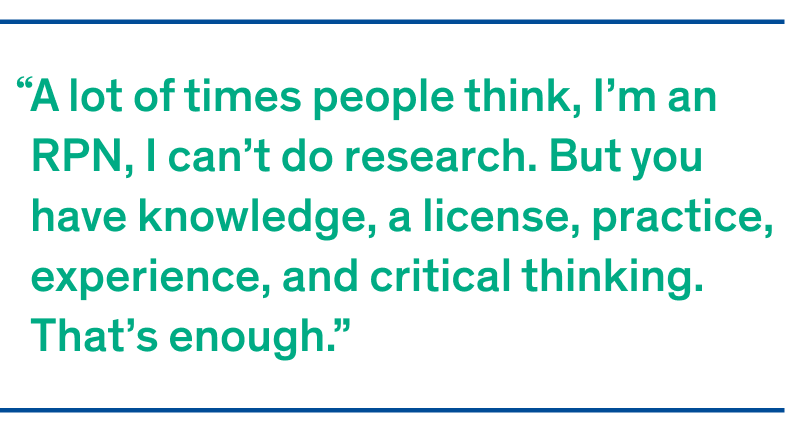
For RPNs considering research of their own, Marissa’s advice is simple: just do it. “The hardest part is getting started,” she says. Find a mentor, lean on your organization’s resources, and have confidence in what you bring. “A lot of times people think, I’m an RPN, I can’t do research. But you have knowledge, a license, practice, experience, and critical thinking. That’s enough.” As she puts it, research is problem-solving and the same critical thinking RPNs use at the bedside every day, just with different tools.
Looking ahead, Marissa is completing a master’s in counselling psychology, with an eye toward expanding psychotherapy skills within her nursing practice. And she’s optimistic about the profession’s trajectory. “The RPN role holds so much more value than one would even think,” she says. “We’ve gone from being the assistant to being recognized as nurses who do research and sit as key stakeholders at the table. There’s so much room for growth, we just need more RPNs to get involved and have their voices heard.”