Linda Sheiban Taucar, RN, MSc., Principal Applicant, Conestoga College
Mark Dager, RPN, Co-Applicant, Woodingford Lodge, Oxford County
Catherine E. Tong, PhD, Co-Applicant, Conestoga College
Ashley Fox, RPN, Knowledge User, Promyse Home Care
Katlynne Elgie, RPN, Knowledge User, Highview Residences

There are ongoing misconceptions that new nurses do not want to work with older adults, or in geriatric-focused care settings. Given the rate at which our population is aging, this is problematic. The reality is that Registered Practical Nurses (RPNs) make up the largest nursing category in the LTC sector and play a similarly critical role in retirement living, home care and other sectors that largely serve older adults.
A recent Canadian study found that new Registered Nurses have a positive attitude towards working with older adults, but only 14% intend to work in a gerontological care settings (Smith et al., 2021). Given the essential role that RPNs play in the aged care sector, we wanted to understand practical nursing students’ attitudes and interest in working with older adults.
Our research project: Are practical nursing students interested in working with older adults?
With funding from WeRPN’s research grant, we were able to examine practical nursing (PN) students’ attitudes, experience and intent to work with older adults.
Our team includes RPNs, RNs and geriatric researchers, all with a commitment to advancing the care of our aging population through applied research and education.
To date, we have conducted surveys and in-depth interviews with twelve PN students in their final term of studies.
The COCOA survey: It isn’t ageism or a lack of interest in geriatrics.
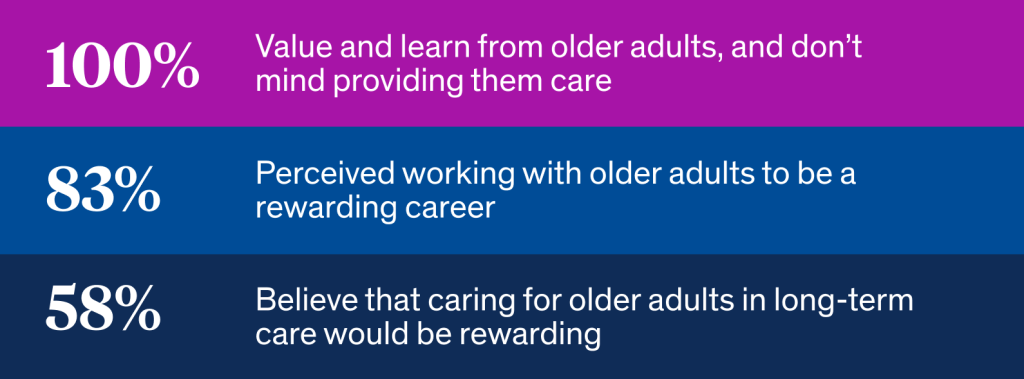
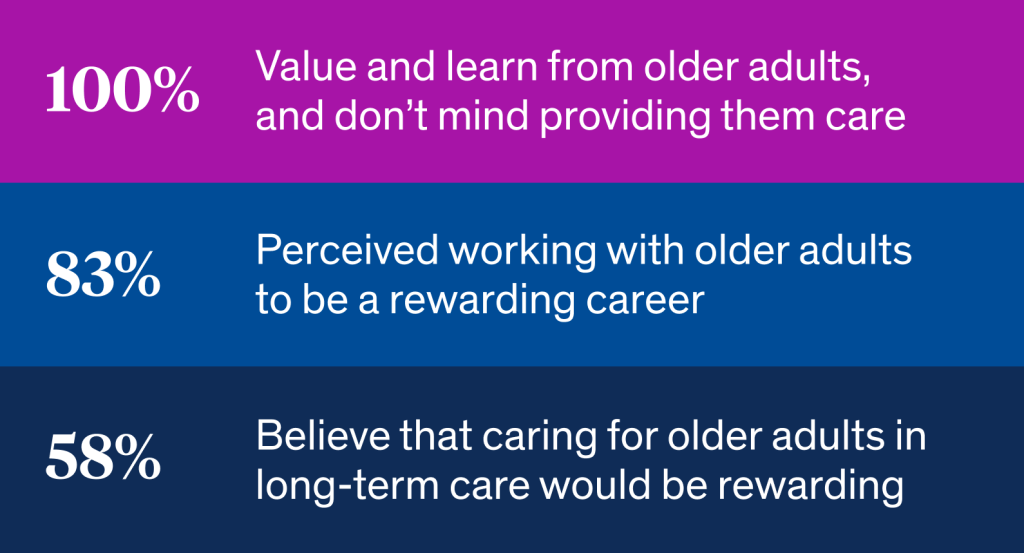
Our results have been surprising. The PN student participants in our study have scored highly on the COCOA (Carolina Opinions on Care of Older Adults) survey. All participants (100%) believe that older adults are valuable contributors to society, that they have much to learn from older adults, and do not mind providing care to older adults. In addition, eighty-three percent (83%) perceived working with older adults to be a rewarding career; however fewer (58%) believe that caring for older adults in long-term care would be rewarding.
The interviews: It’s the system and stigma.
Despite high COCOA scores, many participants reported feeling hesitant to seek careers in long-term care (LTC) and retirement living settings. Upon completion of the COCOA survey, participants emphasized that their concerns were not related to ageism, or their lack of interest in geriatrics; rather, they were hesitant to seek work in the sector because of the working conditions (e.g. fewer nursing colleagues to collaborate with/learn from, lower salaries, fewer opportunities for advancement/specialization).
“At the hospital you have time management…and you have more support. While at the long-term care you have less support” – study participant
A perceived limited scope of nursing practice outside of hospitals and acute care was also a concern with one participant stating “So I would say the majority of our day is 98% is all just like Med pass, Med pass, Med pass continuous and you’re just like, running around crazy.”
However, students who wished to work in LTC upon graduation saw the skills that they would obtain from the environment. When asked if there were any specific skills that they developed through their LTC placement that may be unique to what they acquired in acute care, participants felt strongly that interacting and communication skills were further developed. “During my time in (LTC in Ontario) I had a lot of interaction, interacting with the client a lot because when it comes to giving them the meds, some of them may be reluctant, but then I learned that, you know, you just have to talk to them. You know, communicate with them.” – study participant
Key takeaways:
PN students in their final semester want to work with older adults, and many are interested in working in LTC and retirement living. The majority of the PN students we spoke to discussed feeling that roles in LTC and retirement living have a limited scope of practice, and that they would have few peers to collaborate with and learn from.
The narrative that nurses will “lose their skills” is pervasive, and an important point of intervention both during the PN education journey, and in aged care workplaces where the role and scope of the RPN should be championed and supported. Within our research centre and workplaces, we are exploring ways to challenge misconceptions, highlight the value of RPNs in the aged care sector, and reimagine the RPN role in retirement and long-term care so nurses can fully use their skills and scope of practice. This will remain a focus of our ongoing work. If you have ideas or best practices to help achieve these goals, please contact us at chcri@conestogac.on.ca
References:
Smith, J., Sawhney, M., Duhn, L., & Woo, K. (2022). The association between new nurses’ gerontological education, personal attitudes toward older adults, and intentions to work in gerontological care settings in Ontario, Canada. Canadian Journal of Nursing Research, 54(2), 190-198.
WeRPN. (2020). Addressing gaps in Ontario’s long-term care system during COVID-19: Recommendations to the long-term care COVID-19 commission. WeRPN. Accessed from: https://www.werpn.com/wp-content/uploads/2020/09/WeRPN-Submission-to-Commission-on-LTC-and-Covid-FINAL.pdf